
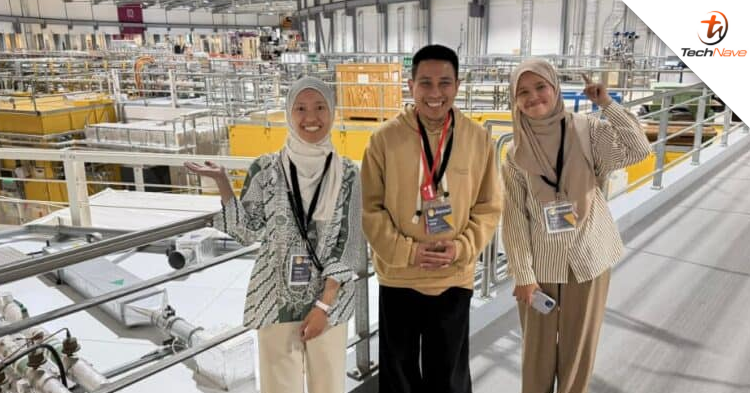
Three young researchers from the Permatang Pauh Campus of Universiti Teknologi MARA (UiTM), Penang Branch, have been chosen to conduct experiments at the prestigious ISIS Neutron and Muon Source in the United Kingdom. Their project, which focuses on developing catalytic materials to break down microplastics, successfully passed a rigorous international selection process, proving that Malaysian scientists can compete on the global stage.
A project to break down microplastics and reuse them efficiently
This three-year project focuses on developing catalytic materials to degrade microplastics, alongside "upcycling" methods to convert plastic waste into high-value products. The team is led by senior lecturer Ir. Ts. Mohamed Syazwan Osman, working alongside two PhD students, Nur Lina Syahirah Mustapa and Anis Syuhada Saufi.
Using the advanced LARMOR Small-Angle Neutron Scattering (SANS) instrument, the team is collaborating closely with UK scientists to analyse material structures at the atomic and nanometer scale. This precise data is essential for designing more efficient catalytic materials, which could hold the key to future microplastic treatment technologies.
Moreover, this study does more than just tackle the critical issue of global microplastic pollution. It also opens doors for Malaysia to cultivate native expertise in high-impact research. Beyond the immediate scientific breakthroughs, the collaboration strengthens international networks, drives knowledge transfer, and nurtures young local talent.
A recurring milestone for Malaysia
Notably, this is not the first time a Malaysian public university has conducted research at this renowned facility. In 2025, a research group from Universiti Malaysia Perlis (UniMAP) also conducted a study here, successfully testing geopolymer coating materials at Engin-X, a state-of-the-art stress analysis beamline at the ISIS Neutron and Muon Source. This marked a major milestone, as it was the first time geopolymer materials were tested at Engin-X, a facility that has historically focused on iron-based materials and alloys.
The successive achievements of these researchers prove that Malaysian expertise is fully capable of pioneering sustainable solutions, ultimately raising the country's prestige in the global scientific arena. What are your thoughts on this breakthrough? Feel free to leave your comments below!
Stay tuned to TechNave.com for more tech and science updates like this.



COMMENTS