
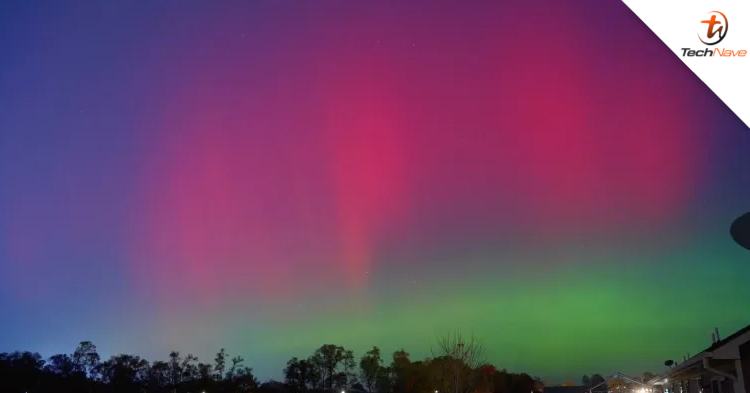
The world's skies are expected to once again be adorned with spectacular aurora lights from Wednesday night into Thursday, following unusually strong solar activity, but the phenomenon also carries the risk of disruption to communications and satellite systems. So, what should you know about it?
Solar storm expected to continue until Thursday
According to the US National Oceanic and Atmospheric Administration (NOAA), this rare event began earlier this week and is expected to continue until Thursday, following a series of large eruptions of solar particles from the Sun's surface, known as " coronal mass ejections " (CMEs).
For your information, these high-energy particles reach Earth's atmosphere, they trigger a level 4 out of 5 geomagnetic storm, producing green and pink flashes of light in the sky far from the polar regions. On Tuesday night, the sky as far as Mexico was also lit up by the aurora borealis, something extremely rare and usually only visible in the north or south polar regions.
Meanwhile, in the southern hemisphere, residents of Australia and New Zealand also reported witnessing the stunning phenomenon. Last year, the world witnessed its first level 5 geomagnetic storm in two decades, which produced the most dramatic displays of northern and southern lights in modern history. However, despite the beauty, strong solar storms carry great risks.
It will affect us significantly
Moreover, it can cause disruption to radio communication systems, GPS navigation, and satellite operations, and even burden the electrical power grid. This impact was also felt by the space exploration company Blue Origin, owned by Amazon founder Jeff Bezos, which was forced to postpone the launch of the New Glenn rocket again on Wednesday due to the risk of disruption from the solar activity.
For astronomy enthusiasts, NOAA advises finding dark sky areas away from city lights for the best chance of seeing the aurora. If the light is not visible to the naked eye, a camera or smartphone with a long exposure setting can help capture a soft glow of green and purple on the horizon.
The phenomenon is a reminder that while the Earth rotates peacefully, the Sun is always active and full of surprises, giving us both cosmic beauty and the challenges of modern technology.
Stay tuned to TechNave.com for more updates.




COMMENTS