
Huawei’s Clement Wong, Head of Global Product Marketing recently held a media roundtable here in Malaysia to discuss their HarmonyOS and Kirin 990 chipset. At the event he confirmed that not only is the open source microkernal-based HarmonyOS designed and made for all scenarios meant to go beyond Android, Linux or iOS but it is also likely coming to Malaysia, so HarmonyOS powered devices may soon be available outside of China as well.
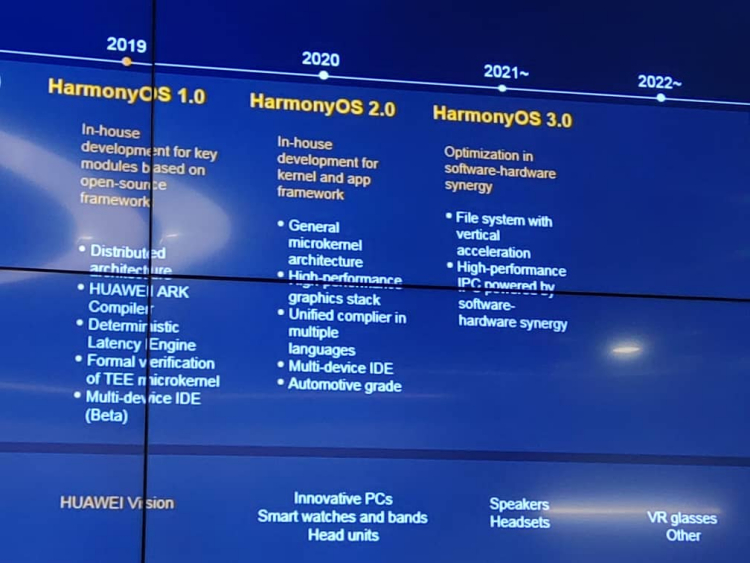
In development since 2016 after their first IoT (Internet of Things) operating system, LiteOS, HarmonyOS is “mainly targeted for smart devices such as wearables, HUAWEI Vision, and head units” but in the slides at the event we spotted PC and Automotive usage as well, indicating that Huawei’s HarmonyOS may replace Microsoft Windows in laptops or be used in car head units. The HarmonyOS roadmap slide in particular says we could see these HarmonyOS powered PCs and Automotive grade devices in 2020 for HarmonyOS 2.0.
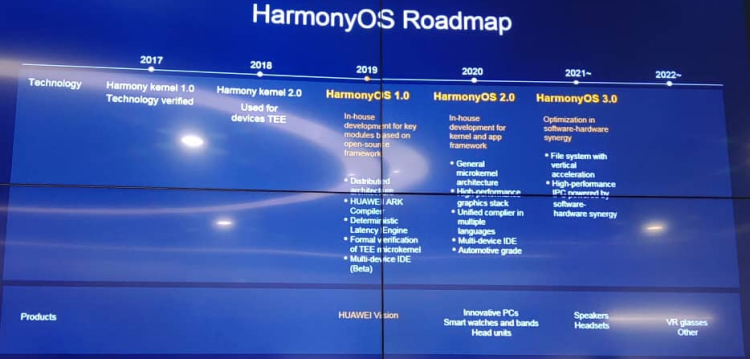
The cool thing about this is that HarmonyOS is designed to work with all devices. So if you were to code and compile a Maps app for a HarmonyOS PC, it would be just as usable in a HarmonyOS smartwatch, head unit or dashboard. Huawei goes on to say that while both the HarmonyOS and EMUI may look the same, the 2 are “independent of each other” and that “Huawei will continue to introduce the most innovative products and technologies” for Malaysia.
Huawei didn’t elaborate on any specific Malaysia release dates or much less pricing details though and while they didn’t confirm whether or not HarmonyOS will be used to power their phones or other mobile devices, they didn’t deny it outright either (remember that quote on “all scenarios”?).Considering this, would you be interested in a HarmonyOS powered Huawei Mate 30 series smartphone? What do you think? We won’t have to wait long as the Huawei Mate 30 series is expected to be announced as soon as 19 September 2019 in Germany.



COMMENTS