

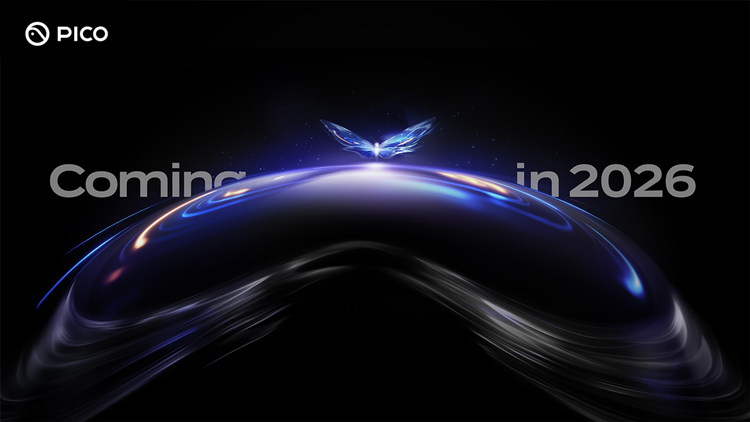
PICO has officially introduced PICO OS 6, describing it as a fundamental rebuild of its spatial operating system rather than a routine upgrade. Alongside the software reveal, the company also offered an early preview of its upcoming flagship XR hardware, internally codenamed Project Swan.
According to PICO, the new operating system rethinks spatial computing architecture from the ground up. It is designed to eliminate long-standing friction in XR environments by enabling 2D apps, 3D experiences, virtual environments, and physical reality to coexist seamlessly within a single interface. A new headset built to pair with PICO OS 6 is also in development, combining upgraded hardware with the enhanced software platform.
PICO Spatial Engine
At the core of PICO OS 6 is the PICO Spatial Engine, a unified rendering architecture that shifts the rendering pipeline from the application level to the operating system level. Instead of handling graphics separately within each app, the OS now manages rendering centrally. This allows 2D windows, 3D objects, immersive environments, and passthrough views of the physical world to run simultaneously while maintaining responsiveness. The approach ensures multiple 3D apps and floating 2D windows operate harmoniously, creating a more fluid blend between virtual and real-world elements.
Spatial Multitasking
Built on the Spatial Engine, PICO OS 6 introduces spatial multitasking capabilities. Users can collaborate on complex 3D models with colleagues represented as avatars while keeping web browsers and notes floating above a physical desk. The input system adapts dynamically to user needs without requiring manual mode switching.
Navigation can be handled with simple look-and-pinch gestures, XR controllers can be used for gaming, and traditional keyboard and mouse setups remain supported for productivity tasks. For the more than 2600 enterprise institutions PICO serves, this architecture is positioned as a stable and responsive digital workspace for professional collaboration.
Open Ecosystem Across XR and Web Platforms
PICO OS 6 is built around an open ecosystem philosophy. The system treats Spatial apps, OpenXR, WebXR, Android apps, web apps, and PC VR streaming as equal components within the platform. By lowering development barriers and unifying distinct ecosystems into a single user experience, PICO aims to provide a flexible environment that benefits both developers and end users.
Expanded Developer Toolkit and WebSpatial Framework
To support creators, PICO is launching a comprehensive development toolkit. The new PICO Spatial SDK built with Kotlin and an updated UI system offer component-based APIs and unified runtime adaptation. With the PICO Spatial Plugin for Android Studio and a desktop-based PICO Emulator, developers can design, code, and test applications without requiring a headset.
PICO is also introducing WebSpatial, an open-source framework that brings standard web technologies such as HTML, CSS, and React into spatial computing. WebSpatial enables install-free, cross-platform apps that run across PICO OS, Apple VisionOS, and AndroidXR environments.
Support for Unity and Unreal Engine has been deepened, allowing developers to create mixed reality games that run alongside 2D and 3D apps. This enables multitasking during gameplay, such as video chatting or browsing in floating windows while gaming.
Project Swan Targets Major Hardware Leap in 2026

While PICO OS 6 lays the software foundation, Project Swan is positioned as the hardware breakthrough required to fully realize this new computing paradigm. Project Swan features next-generation MicroOLED displays with nearly 4000 PPI pixel density, roughly nine times that of flagship smartphones. The optical system delivers an average of 40 Pixels Per Degree with a center sweet spot exceeding 45 PPD, aiming to produce text clarity suitable for professional workflows.
For mixed reality, Project Swan introduces a dual-chip architecture supported by custom XR silicon. A dedicated XR chip manages perception and imaging engines, fusing data from multiple sensors to construct a real-world representation with approximately 12 milliseconds of latency. The headset also integrates a flagship SoC that delivers more than double the CPU and GPU performance compared to the current XR2 Gen 2 platform. Project Swan is targeting a global launch in late 2026.
PICO Global Early Access Program Now Open
PICO has also opened its PICO Global Early Access Program, inviting experienced users to participate in a closed beta test for Project Swan and PICO OS 6. Applications for the early access program are now available through PICO’s official website. Stay tuned for more trending tech news at TechNave.com.



COMMENTS